How Tellus put its own tools and AI inside every Chatwoot conversation
Tellus self-hosts Chatwoot Enterprise and puts its own account tools and an in-house AI analyst beside each conversation. By October, first replies during support hours came 45% faster than before the switch, while conversation volume grew about 30%.
At a glance
- Company
- Tellus App, Inc.: savings, property management software and lending
- Headquarters
- Silicon Valley
- Support team
- 3 team members in 3 time zones
- Conversations
- About 940 a month, up 30%
- On Chatwoot since
- August 4, 2026
- Deployment
- Chatwoot Enterprise, self-hosted by Tellus, VPN-only
- Channels
- In-app chat, mirrored from the Tellus app, and email
- Built with
- Dashboard Apps, Captain Copilot, and Atlas, Tellus's AI agent platform
- Time to go live
- 8 days from requirements to first replies
- Result
- First replies 45% faster by October
Conversation volume grew about 30% over the same period.
“We wanted our support team to see all of the most critical customer information at a quick glance, all in the same place, so they can give an exact answer. Chatwoot let us run the platform ourselves and bring our own tools and our own AI into it.”
 Matheus OliveiraAI Product Engineer, Tellus
Who is Tellus?
Tellus brings savings tools, property management and lending together in one app, all powered by real estate. Founded in 2016 and headquartered in Silicon Valley, Tellus completed a seed financing led by Andreessen Horowitz in 2022. It serves savers and landlords, who use it to collect rent, manage units, handle maintenance requests and list properties. Its Android app has more than 100,000 downloads. Many of the questions customers bring to support are about money: a deposit, a Boost, a rent payment.
The problem: the answers lived in another tab
Until August 2026, each in-app chat message became a ticket in a separate queue, and the team replied from there. Support email arrived in a shared inbox. To answer most questions, a team member opened Tellus’s admin console in another tab to check a balance, a Boost or a referral.
Tellus already had the tools. They were not where the conversation was. For a financial product, that gap matters: a question about a deposit needs the account facts in front of the person answering, and the answer must be exact.
Why Tellus chose Chatwoot
Tellus first priced a hosted support suite with a separate AI add-on, and set it aside on cost. On July 27, Jeromy Hiserote, VP, Head of Operations and Customer Success, wrote down what the support team needed. Matheus Oliveira, the AI product engineer who ran the evaluation, had a Chatwoot proof of concept running the next day. Of 34 requirements, it met 14 outright and partly met 14 more.
“Because it’s open source, it’s really easy to do a proof of concept in a couple of hours. Of our 34 requirements, 14 were met on day one and 14 more were partly met, and we knew exactly what the rest needed.”
Tellus engineers built the infrastructure foundation overnight on July 28–29, with AI coding assistance, in an environment Tellus owns and controls. Chatwoot was online on Tellus’s VPN on July 30, and Tellus bought four Enterprise licenses the same day.
- Jul 27The support team writes its requirements
- Jul 28The proof of concept meets 14 of 34 requirements and partly meets 14 more
- Jul 28–29Tellus engineers build the infrastructure foundation overnight, with AI coding assistance
- Jul 30Chatwoot is online over Tellus's VPN; Tellus buys four Enterprise licenses
- Jul 31In-app chat starts to mirror into Chatwoot
- Aug 3–7Engineers and the support team work side by side in Kansas City
- Aug 4The support team replies to customers from Chatwoot
- Aug 6Support email moves into Chatwoot
- Aug 14Tellus switches off its old ticket queue
Bringing Tellus’s own tools into every conversation
Every Tellus conversation in Chatwoot opens with Tellus tabs beside it, all built as Chatwoot Dashboard Apps. Four show the customer’s account from Tellus’s admin system, a fifth is for account actions, and the last is CS-Lead, Tellus’s own AI support analyst.
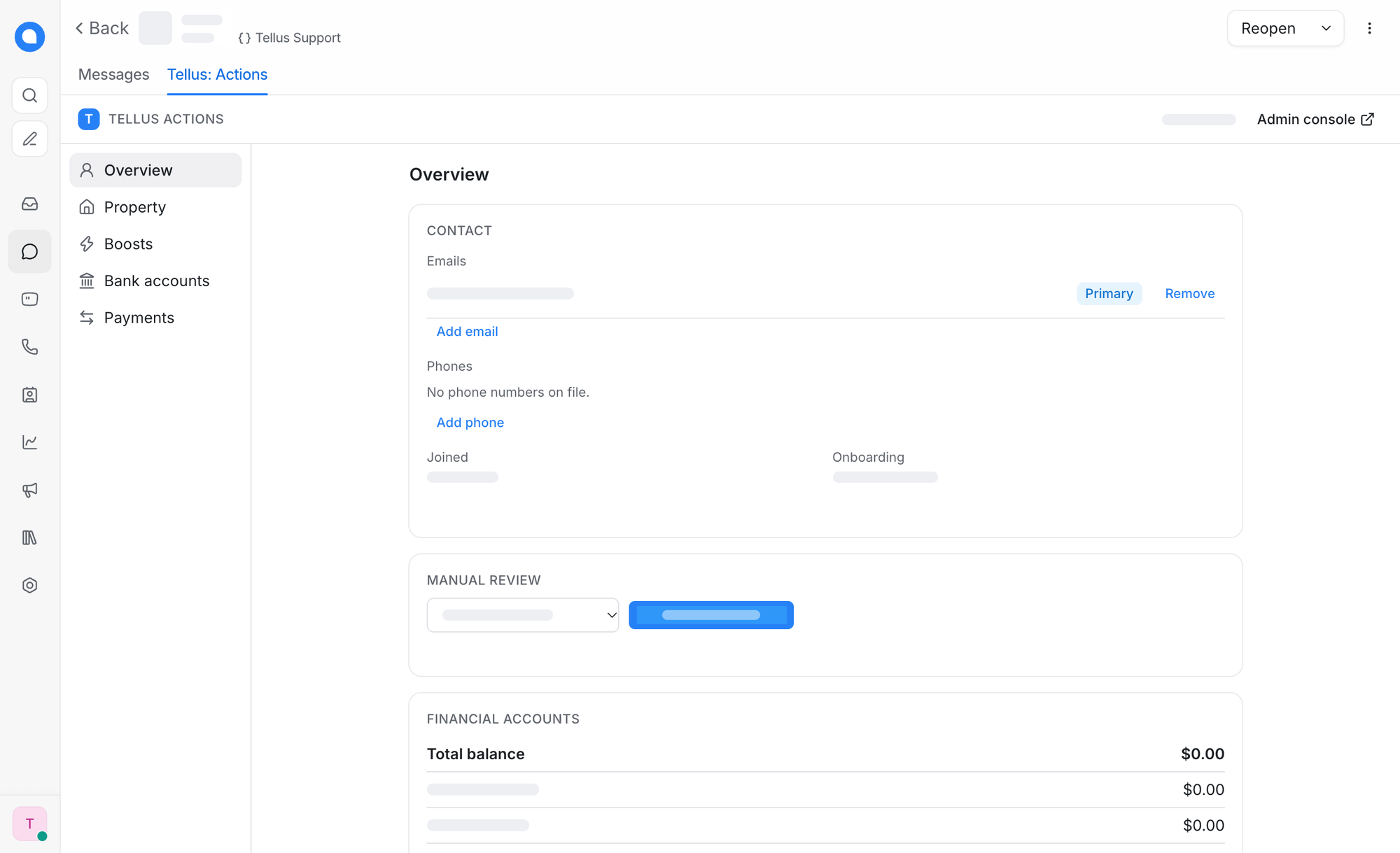
Each team member signs in as themselves. A pop-up signs them in through Tellus’s single sign-on and issues a short-lived token. Every request re-checks their role, and the audit trail records their own name.
1CS-Lead, an AI analyst that knows Tellus’s product
CS-Lead runs on Atlas, the AI agent platform Tellus built for its own engineering work. In the CS-Lead tab, a team member asks about a case. CS-Lead asks specialist AI agents that each know one part of Tellus’s product, then answers in plain words. Inside Captain Copilot, the team member can consult CS-Lead without leaving the reply editor, because Tellus added that tool at the model endpoint Copilot calls.
2Guardrails in the system, not the prompt
- CS-Lead gives signed-in team members account context, and controls filter specified identifiers, such as names, contact details, and bank and card numbers, from its answers.
- In this workflow, CS-Lead has no tool that changes customer account data or sends a customer-facing message.
- Tellus loads its approved FAQ into Captain word for word, and team members review every suggested draft before they send it.
3Self-hosted by Tellus
Tellus runs Chatwoot Enterprise in a separate environment that Tellus owns and controls, rather than in Chatwoot’s cloud. Team members reach it only through Tellus’s company VPN and single sign-on, and defined, authenticated integrations connect it to the services the team needs. Chatwoot runs from the official container image, pinned to an exact version, and every change goes through a reviewed deployment pipeline.
4Nothing changed for customers
Customers still chat inside the Tellus app. A two-way bridge carries each in-app message into Chatwoot and each reply from the team back to the customer’s chat. The bridge uses message identifiers to detect duplicates and to stop replies from looping back. About six months of chat history came across with original timestamps, and profile fields from Tellus’s backend sync to each Chatwoot contact.
Today, Tellus runs support on its own terms
The support team answered customers from Chatwoot on August 4, eight days after writing its requirements. Ten days later, Tellus switched off its old ticket queue, and support email moved into Chatwoot as well.
In October, the median wait for a first reply from a person during support hours was 45% shorter than in May through July, before the switch. Across September and October it was 36% shorter, while total conversation volume grew about 30%. The slowest replies improved too: in October, the 90th-percentile wait was 30% shorter.
| Measure (support hours unless stated) | Change after the switch |
|---|---|
| Median wait for a first reply, October | 45% shorter |
| Median wait for a first reply, September 1–October 31 | 36% shorter |
| 90th-percentile wait, October | 30% shorter |
| Replies within 30 minutes, September 1–October 31 | Up 6 points, to 83% |
| Conversations per day, all hours | Up 30% |
| Customers who wrote back within a week | Unchanged, 15–20% every month |
“We switched off our old ticket queue days after we went live and haven’t needed it or looked back since. The account details and quick actions sit right in the conversation, so our answers are quicker and easier.”
What comes next
Tellus plans to roll out a Captain assistant in stages, starting with triage, and to move its help center into Chatwoot so “Contact us” opens a live chat.
“We’re getting more free time for the team and getting them to be quicker. Our goal, especially for customer service, is to use that free time to be more proactive.”
Six lessons for other teams
Start where the customer already is.
Tellus kept its in-app chat and mirrored it into Chatwoot, so customers kept the chat they knew.
Bring in the tools you have; do not rebuild them.
Dashboard Apps let Tellus embed admin views it already ran, with each team member signed in as themselves.
Put AI guardrails in the architecture, not the prompt.
CS-Lead talks only to the team, never to customers, and the tools that change data are removed from it.
Load approved answers word for word.
In finance, a reworded rate or limit can be wrong, so Tellus imports its approved FAQ text as written.
Isolate first, connect second.
Chatwoot runs in a separate environment that Tellus controls, and each integration reaches Tellus systems through one defined, authenticated channel.
Measure the customer's wait, and check quality alongside it.
Tellus measured first replies from its own chat records and watched repeat contacts, so faster did not mean worse.
How Tellus measured the result: from its own in-app chat records, which hold every customer message and every reply from the team before and after the switch. A conversation starts with a customer message after 24 hours of quiet. Support hours are Monday to Friday, 9 a.m. to 5 p.m. Pacific. Automated welcome messages do not count as replies. Other things also changed between the periods, so read this as the result after the switch, not proof of cause.
About Tellus. Tellus App, Inc. is a real estate and financial technology company headquartered in Silicon Valley, offering consumer cash accounts powered by real estate, property management software for independent landlords, and business-purpose residential lending. Tellus is not a bank. Tellus is not FDIC-insured. The FDIC-insured Deposit Account is provided by Central Bank of Kansas City, Member FDIC. Learn more at tellusapp.com.